Mathematics syllabus for the JEE Main . Mathematics is often called the heart of JEE preparation — and for good reason. It’s not only the most scoring subject in the Joint Entrance Examination (JEE Main and Advanced), but also the one that can make or break your overall percentile. While Physics and Chemistry have conceptual and experimental aspects, Mathematics is entirely logical — there’s no scope for rote learning. Mathematics syllabus for the JEE Main
Fill Form For Free Counselling
Official JEE Resources
Mathematics syllabus for the JEE Main
JEE Main Maths Syllabus 2026
Candidates are provided below detailed JEE Maths syllabus with every topic covered in the exam. Candidates can also download the syllabus as a PDF.
| Units | Topics |
| Sets, Relations and Functions | Sets and their representation: Union, intersection and complement of sets and their algebraic propertiesPower set: Relation, Type of relations, equivalence relations, functionsOne-one, into and onto functions, the composition of functions. |
| Complex Numbers and Quadratic Equations | Complex numbers as ordered pairs of realsRepresentation of complex numbers in the form a + ib and their representation in a planeArgand diagramAlgebra of complex numberModulus and argument (or amplitude) of a complex numberSquare root of a complex numberTriangle inequalityQuadratic equations in real and complex number system and their solutionsRelations between roots and coefficient, nature of roots, the formation of quadratic equations with given roots. |
| Matrices and Determinants | MatricesAlgebra of matricesType of matrices,Determinants and matrices of order two and threeProperties of determinantsEvaluation of determinantsArea of triangles using determinantsAdjoint and evaluation of inverse of a square matrix using determinants and elementary transformationsTest of consistency and solution of simultaneous linear equations in two or three variables using determinants and matrices |
| Permutations and Combinations | Fundamental principle of countingPermutation as an arrangement and combination as section,Meaning of P (n,r) and C (n,r)Simple applications. |
| Binomial Theorem and its Simple Applications | Binomial theorem for a positive integral indexGeneral term and middle termProperties of Binomial coefficients and simple applications. |
| Sequence and Series | Arithmetic and Geometric progressionsInsertion of arithmeticGeometric means between two given numbers,Relation between A.M and G.M sum up to n terms of special seriesSn, Sn2, Sn3Arithmetico-Geometric progression |
| Limit, Continuity and Differentiability | Real-valued functionsAlgebra of functionspolynomials, rational, trigonometric, logarithmic and exponential functionsInverse function. Graphs of simple functions. Limits, continuity and differentiability. Differentiation of the sum, difference, product and quotient of two functions.Differentiation of trigonometric, inverse trigonometric, logarithmic, exponential, composite and implicit functions;Derivatives of order up to twoRolle’s and Lagrange’s Mean value Theorems, Applications of derivativesRate of change of quantities, monotonicI ncreasing and decreasing functions,Maxima and minima of functions of one variable, tangents and normal. |
| Integral Calculus | Integral as an anti-derivativeFundamental Integrals involving algebraic, Trigonometric, exponential and logarithms functions.Integrations by substitution, by parts and by partial functions.Integration using trigonometric identities. Integral as limit of a sum.The fundamental theorem of calculus, properties of definite integrals.Evaluation of definite integrals, determining areas of the regions bounded by simple curves in standard form.Mathematics syllabus for the JEE Main |
| Differential Equations | Ordinary differential equations, their order and degree,Formation of differential equationsSolution of differential equation by the method of separation of variablesSolution of a homogeneous and linear differential equation. |
| Co-ordinate Geometry | Cartesian system of rectangular coordinates in a planeDistance formula, sections formulaLocus and its equation,Translation of axes, the slope of a line, parallel and perpendicular lines, intercepts of a line on the co-ordinate axis.Straight line: Various forms of equations of a line, intersection of lines, angles between two lines, conditions for concurrence of three lines, the distance of a point form a line, equations of internal and external by sectors of angles between two lines co-ordinate of the centroid, orthocentre and circumcentre of a triangle, equation of the family of lines passing through the point of intersection of two lines.Circle, Conic sections: A standard form of equations of a circle, the general form of the equation of a circle, its radius and central, equation of a circle when the endpoints of a diameter are given, points of intersection of a line and a circle with the centre at the origin and condition for a line to be tangent to a circle, equation of the tangent, sections of conics, equations of conic sections (parabola, ellipse and hyperbola) in standard forms, condition for Y = mx +c to be a tangent and point (s) of tangency |
| 3D Geometry | Coordinates of a point in spaceDistance between two pointsSection formula, directions ratios and direction cosines, the angle between two intersecting lines.Skew lines, the shortest distance between them and its equation.Equations of a line and a plane in different forms, the intersection of a line and a plane, coplanar lines. |
| Vector Algebra | Vectors and scalars,Addition of vectors, components of a vector in two dimensions and three-dimensional spaceScalar and vector products, scalar and vector triple product. |
| Statistics and Probability | Measures of discretionCalculation of mean, median, mode of grouped and ungrouped data calculation of standard deviation, variance and mean deviation for grouped and ungrouped data.Probability: Probability of an event, addition and multiplication theorems of probability, Baye’s theorem, probability distribution of a random variate, Bernoulli trials and binomial distribution. |
| Trigonometry | Trigonometrical identities and equationsTrigonometrical functions,Inverse trigonometrical functions and their properties, heights and distance. |
To crack JEE Maths, you need three things:
- A deep understanding of the syllabus,
- Consistent problem-solving practice, and
- A smart strategy for revision and time management.
In this detailed blog, you’ll find everything you need — the complete JEE Maths syllabus (unit-wise), topic priorities, chapter-wise strategies, and proven tips that have helped toppers secure 99+ percentile.
JEE Main 2026 Mathematics Weightage of Topics
Candidates can check below the weightage of different topics of Mathematics in JEE Main 2026. The chapterwise weightage varies from year to year and also for every session within a year. The weightage of topics given here is based on analysis of previous year JEE Main question papers.
| Chapters | Total Questions | Weightage |
|---|---|---|
| Sets | 1 | 3.3% |
| Permutations & Combinations | 1 | 3.3% |
| Probability | 1 | 3.3% |
| Complex Numbers | 1 | 3.3% |
| Binominal Theorem | 1 | 3.3% |
| Limits | 1 | 3.3% |
| Differentiability | 1 | 3.3% |
| Indefinite Integration | 1 | 3.3% |
| Definite Integration | 1 | 3.3% |
| Differential Equations | 1 | 3.3% |
| Height & Distance | 1 | 3.3% |
| Trigonometric Equations | 1 | 3.3% |
| The Area under the Curve | 1 | 3.3% |
| Quadratic Equations | 1 | 3.3% |
| Vectors | 1 | 3.3% |
| Tangents and Normals | 1 | 3.3% |
| Maxima and Minima | 1 | 3.3% |
| Statistics | 1 | 3.3% |
| Parabola | 1 | 3.3% |
| Ellipse | 1 | 3.3% |
| Hyperbola | 1 | 3.3% |
| Mathematical Reasoning | 1 | 3.3% |
| Sequences & Series | 2 | 6.6% |
| Straight Lines | 2 | 6.6% |
| 3-D Geometry | 2 | 6.6% |
| Determinants | 2 | 6.6% |
Best Books for JEE Main 2026 Maths
Candidates must select the right book to prepare for the exam. Books play a very important role in securing good marks in any exam. Candidates can check below the best books for Maths that they can refer to for JEE Main 2026 preparation.
| Name of Book | Author/Publisher |
| NCERT class 11 and 12 Textbooks | NCERT |
| Trigonometry | Arihant Publications |
| Differential Calculus for IIT JEE | Amit Agarwal-Arihant Publications |
| Coordinate Geometry and Vector | Arihant Publications |
Section 1: Overview of JEE Maths
Mathematics in JEE Main is a 100-mark section (25 questions — 20 MCQs and 5 numerical value type). Each question carries 4 marks with a negative marking of −1 for incorrect answers (in MCQs). Mathematics syllabus for the JEE Main
The syllabus covers the entire scope of Class 11 and 12 Mathematics as prescribed by NCERT, but the questions demand application-level understanding. JEE Advanced goes a step further, testing analytical depth and multi-concept problems.
To begin with, let’s understand what’s inside the syllabus. Mathematics syllabus for the JEE Main
Section 2: Complete JEE Maths Syllabus (2025)
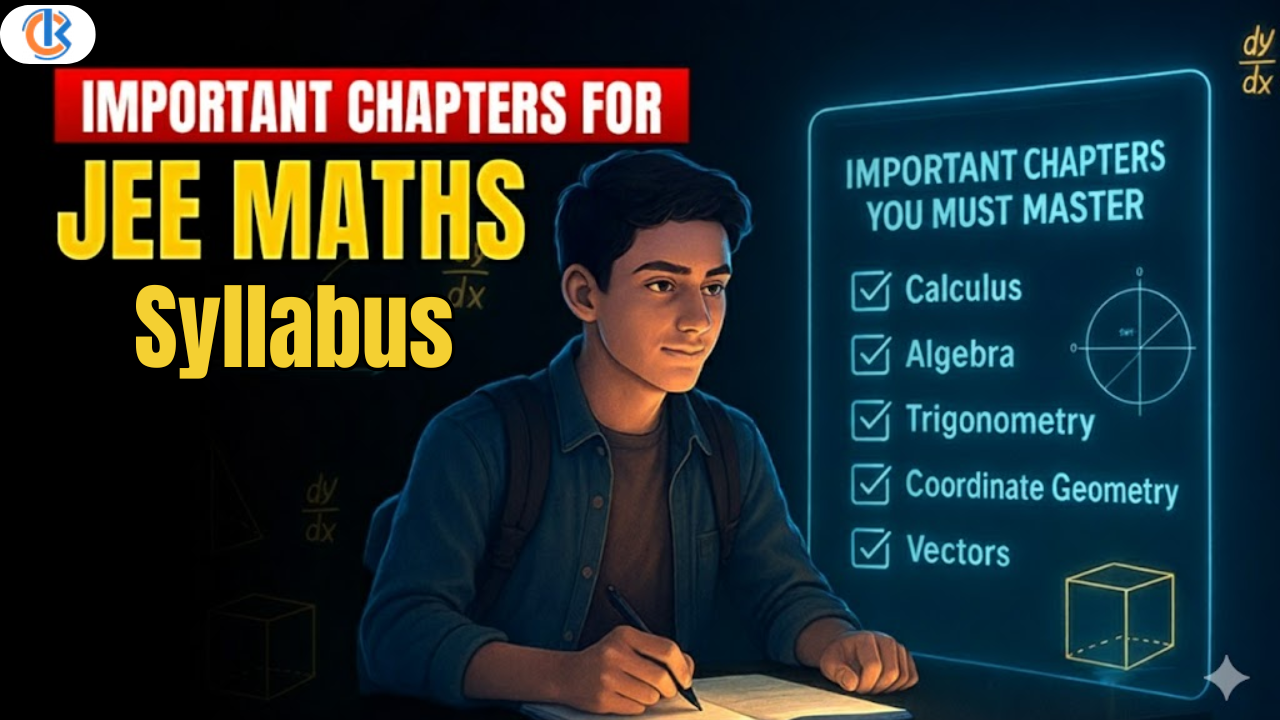
The syllabus can be grouped into five broad units:
- Algebra
- Calculus
- Coordinate Geometry
- Vector and 3D Geometry
- Probability, Statistics & Miscellaneous Topics
Let’s explore each in detail.
Mathematics syllabus for the JEE Main
1. Algebra
Algebra forms the backbone of JEE Maths. It’s vast, but highly scoring once you understand the patterns.
Important Chapters:
- Sets, Relations and Functions:
Sets and their representation, Venn diagrams, operations on sets, relations (reflexive, symmetric, transitive), and types of functions — one-one, onto, inverse, and composite functions. - Complex Numbers and Quadratic Equations:
Representation on the Argand plane, modulus and argument, De Moivre’s theorem (basic use), roots of quadratic equations, nature of roots, and equations reducible to quadratic form. Mathematics syllabus for the JEE Main - Matrices and Determinants:
Types of matrices, algebra of matrices, properties of determinants, minors and cofactors, adjoint and inverse of matrices, and solutions of linear equations using Cramer’s Rule. - Permutations and Combinations:
Fundamental principle of counting, factorial notation, permutations (arrangements), combinations (selections), and basic applications to problems of probability and counting. - Binomial Theorem and Its Applications:
General term, middle term, simple expansions, and approximation problems using binomial theorem. - Sequence and Series:
Arithmetic, Geometric, and Harmonic progressions, sum to n terms, special series, AM-GM inequality, and relation between AM, GM, and HM. Mathematics syllabus for the JEE Main
2. Calculus
Calculus is the most weighty and conceptually rich part of JEE Maths. It covers both differentiation and integration with their wide applications.
Important Chapters:
- Limits, Continuity, and Differentiability:
Limit concepts, left-hand and right-hand limits, continuity, differentiability, standard derivatives (trigonometric, logarithmic, exponential, inverse trigonometric functions), and chain rule. - Applications of Derivatives:
Tangents and normals, rate of change, increasing/decreasing functions, maxima and minima, and simple optimization problems. - Integrals:
Indefinite integrals, integration as reverse differentiation, integration by substitution, partial fractions, and by parts.
Definite integrals as limits of sums and fundamental theorem of calculus. - Applications of Integrals:
Area under curves, area between two curves — an extremely common question type in JEE Main. - Differential Equations:
Formation of differential equations, first-order linear and separable equations, and basic applications. Mathematics syllabus for the JEE Main
3. Coordinate Geometry
A favorite among students who enjoy visualization, Coordinate Geometry combines algebraic manipulation with geometry.
Important Chapters:
- Straight Lines:
Slope, intercept form, point-slope form, equation of lines parallel and perpendicular, distance of a point from a line, angle between lines, and pair of straight lines. Mathematics syllabus for the JEE Main - Circles:
Equation of a circle in standard and general form, tangent and normal, equation of a circle with given diameter, and intersection of line and circle. - Conic Sections (Parabola, Ellipse, Hyperbola):
Standard equations, focus, directrix, eccentricity, parametric forms, and simple tangent equations.
This area often contributes 4–5 questions in JEE Main — making it a must-master unit. Mathematics syllabus for the JEE Main
Fill Form For Free Counselling
4. Vector Algebra and 3D Geometry
These two topics are interlinked and, once understood, are highly scoring.
Vector Algebra:
- Basics of vectors, magnitude and direction.
- Components of a vector, unit vector.
- Addition, subtraction, and scalar multiplication of vectors.
- Dot product and cross product with their geometric interpretations.
- Applications in geometry and mechanics. Mathematics syllabus for the JEE Main
Three-Dimensional Geometry:
- Direction cosines and ratios.
- Equation of a line in space, shortest distance between two lines.
- Equation of a plane, angle between two planes/lines.
- Distance of a point from a plane.
You can usually expect 2–3 questions directly from this unit. Mathematics syllabus for the JEE Main
Mathematics syllabus for the JEE Main
5. Probability and Statistics
Statistics:
- Mean, median, mode, variance, standard deviation.
- Simple problems on combined data.
Probability:
- Basic probability, conditional probability, total probability theorem, Bayes’ theorem, random variable, and probability distributions.
6. Trigonometry
Although small in syllabus weight, trigonometry acts as a foundation for other topics.
It includes trigonometric ratios, identities, equations, heights and distances, and inverse trigonometric functions.
Mathematics syllabus for the JEE Main
7. Deleted or Reduced Topics (as of recent years)
Over time, the syllabus has been slightly reduced — certain minor topics like Mathematical Induction and Mathematical Reasoning have been removed. Still, some conceptual overlaps may appear, so a basic understanding remains useful. Mathematics syllabus for the JEE Main
Mathematics syllabus for the JEE Main
Section 3: Topic-Wise Weightage (Approximate)
| Unit | Average Weightage | Expected Questions |
|---|---|---|
| Coordinate Geometry | 15% | 4–5 |
| Calculus | 20–25% | 6–7 |
| Algebra | 30% | 7–8 |
| Vector & 3D Geometry | 10% | 2–3 |
| Probability & Statistics | 10% | 2–3 |
| Trigonometry | 5–8% | 1–2 |
While exact distributions vary yearly, this gives you a sense of where to focus most of your time.
Section 4: Chapter-Wise Preparation Tips
1. Algebra
- Practice daily. Algebra requires speed and precision.
- Revise formulas (especially for sequences, matrices, and quadratic equations).
- For P&C, write down small cases manually before generalizing formulas — this builds intuition.
- Complex numbers and quadratic equations are often linked — master their combined applications.
2. Calculus
- Start with limits and continuity — they are the foundation of the entire calculus section.
- Practice derivative problems until differentiation becomes second nature.
- Learn standard integrals; create a “formula grid” of all integral forms.
- Don’t ignore application-based questions — they’re simpler once you know the concept.
- For definite integrals, understand symmetry and property-based shortcuts.
- Mathematics syllabus for the JEE Main
3. Coordinate Geometry
- Visualize every problem with a rough sketch.
- Memorize standard forms of equations (circle, parabola, ellipse, hyperbola).
- Revise formulas for distance, section, and centroid regularly.
- Focus on solving mixed problems that combine lines, circles, and conics.
4. Vector & 3D Geometry
- Be crystal-clear about direction cosines and ratios.
- Practice vector product and scalar triple product — they form the base for most 3D problems.
- Learn to visualize planes and lines — diagrammatic understanding helps enormously.
- Mathematics syllabus for the JEE Main
5. Probability & Statistics
- Probability can be tricky — approach it logically rather than formula-based.
- Solve many problems involving conditional probability and Bayes’ theorem.
- In statistics, understand the meaning of each measure (not just the formula).
6. Trigonometry
- Memorize key identities and learn to derive others.
- Practice solving trigonometric equations and simplifying expressions.
- Heights and distances problems are direct scoring opportunities.
- Mathematics syllabus for the JEE Main
Section 5: Study Plan (12-Month Timeline)
If you’re starting early (say, from Class 11), you can structure your preparation in phases:
Phase 1: Foundation (Months 1–3)
- Focus on Class 11 chapters: Sets, Functions, Quadratic Equations, Sequences & Series, P&C, and Trigonometry.
- Solve NCERT examples and simple problems first.
- Make concise notes of formulas and theorems.
Phase 2: Core Learning (Months 4–6)
- Begin Class 12 syllabus: Calculus, Coordinate Geometry, Matrices & Determinants, Vectors, and Probability.
- After finishing each topic, solve past-year questions related to it.
- Start attempting short topic-wise tests.
Phase 3: Practice & Analysis (Months 7–9)
- Complete the syllabus and begin full-length mock tests every 10–15 days.
- Analyse each test in detail — note mistakes and revise weak areas.
- Solve previous 5 years’ JEE Main papers.
Phase 4: Revision & Exam Readiness (Months 10–12)
- Daily formula revision (30 minutes minimum).
- Full-length timed mocks every 2–3 days.
- Focus on speed, accuracy, and mental stamina.
- In the final month, stop learning new topics — revise and polish what you already know.
Section 6: Tricks and Smart Techniques
- Formula Sheets: Keep a compact notebook with all formulas chapter-wise.
- Flash Revision: Revise formulas while commuting or before sleep — short bursts improve retention.
- Error Log: Maintain a notebook of mistakes from mock tests; revisit it weekly.
- Mixed Problem Sets: Combine topics (e.g., algebra + geometry) to build conceptual integration.
- Time-boxing: While solving questions, set micro-timers. For example, 2 minutes per algebra problem.
- Conceptual Understanding: Always ask “why” before “how.” It deepens retention and adaptability. Mathematics syllabus for the JEE Main
Section 7: Common Mistakes and How to Avoid Them
- Neglecting Basics:
Jumping to advanced books without mastering NCERT concepts leads to confusion. Always start from fundamentals. - Over-reliance on Shortcuts:
Tricks help but only after concept clarity. Don’t replace understanding with rote formulas. - Skipping Revision:
Maths is cumulative — missing revision means forgetting earlier chapters.
Schedule revision every week, even for 15–30 minutes. - Ignoring Mock Test Analysis:
Many aspirants write tests but skip analysis. Identifying why you made mistakes is more important than just taking more tests. - Losing Confidence in Tough Topics:
No chapter is “impossible.” Divide it into sub-topics, and tackle one at a time. Mathematics syllabus for the JEE Main
Section 8: Resources and Books (Recommended)
- NCERT Textbooks (Class 11 & 12) – Foundation and theory.
- RD Sharma / RS Aggarwal – Basic problem solving.
- Arihant Series (by SK Goyal / Amit M Agarwal) – Topic-wise JEE-level questions.
- Cengage / TMH Mathematics for JEE – Advanced-level problem sets.
- Previous Year Question Papers – Must for pattern familiarity.
- Mock Test Platforms (NTA Abhyas / Coaching Apps) – For exam simulation.
Section 9: Time Management During Exam
- Scan the Paper First: Quickly look through all questions to gauge difficulty.
- Attempt in Rounds:
- Round 1 → Easy/known questions.
- Round 2 → Medium difficulty.
- Round 3 → Challenging questions if time permits.
- Avoid Getting Stuck: Spending 10 minutes on one question may cost you 3 easier ones.
- Keep Calm: A clear mind solves faster than a panicked one.
- Check Units and Signs: Many mistakes occur due to simple sign or unit errors. Mathematics syllabus for the JEE Main
Section 10: Mental Preparation and Discipline
Mathematics demands clarity and patience. The journey can be stressful, but consistency pays off.
- Take short breaks during long study sessions.
- Sleep at least 7 hours; a tired brain can’t do algebra.
- Stay away from comparison and negativity — focus on your progress.
- Believe in the process. Improvement is gradual but definite.
Section 11: Quick Revision List
Here’s a crisp “last-month” checklist:
- Formulas: Limits, derivatives, integrals, vector identities, and coordinate geometry equations.
- Graphs: Shapes of standard functions (|x|, x², √x, sin x, ln x).
- Tricky Topics: L’Hôpital’s rule, area under curves, probability theorems.
- Mock Practice: At least 10 full papers under timed conditions.
- Error Revision: Review your mistake notebook thoroughly. Mathematics syllabus for the JEE Main
Section 12: Final Thoughts
Cracking JEE Maths isn’t about being a genius — it’s about being systematic, persistent, and curious. Once you understand the logic behind concepts, maths becomes enjoyable. Remember, the more you practice, the luckier you get. Mathematics syllabus for the JEE Main
Here’s the essence of your JEE Maths success formula:
Concept + Practice + Revision + Calm Mind = High Percentile
Start early, stay consistent, and keep challenging yourself.
Each solved problem takes you one step closer to your dream engineering college.