JEE Main Chemistry Syllabus 2026
Chemistry is one of the three core subjects in the JEE Main 2026 exam and plays a crucial role in determining your overall score. The National Testing Agency (NTA) has recently updated the syllabus, including newly deleted topics to align with the NCERT syllabus.
In this guide, we’ll go through the complete JEE Main Chemistry Syllabus 2026, divided into three parts:
- Physical Chemistry
- Inorganic Chemistry
- Organic Chemistry
and also cover deleted topics from the 2026 syllabus.
JEE Main Chemistry Syllabus 2026
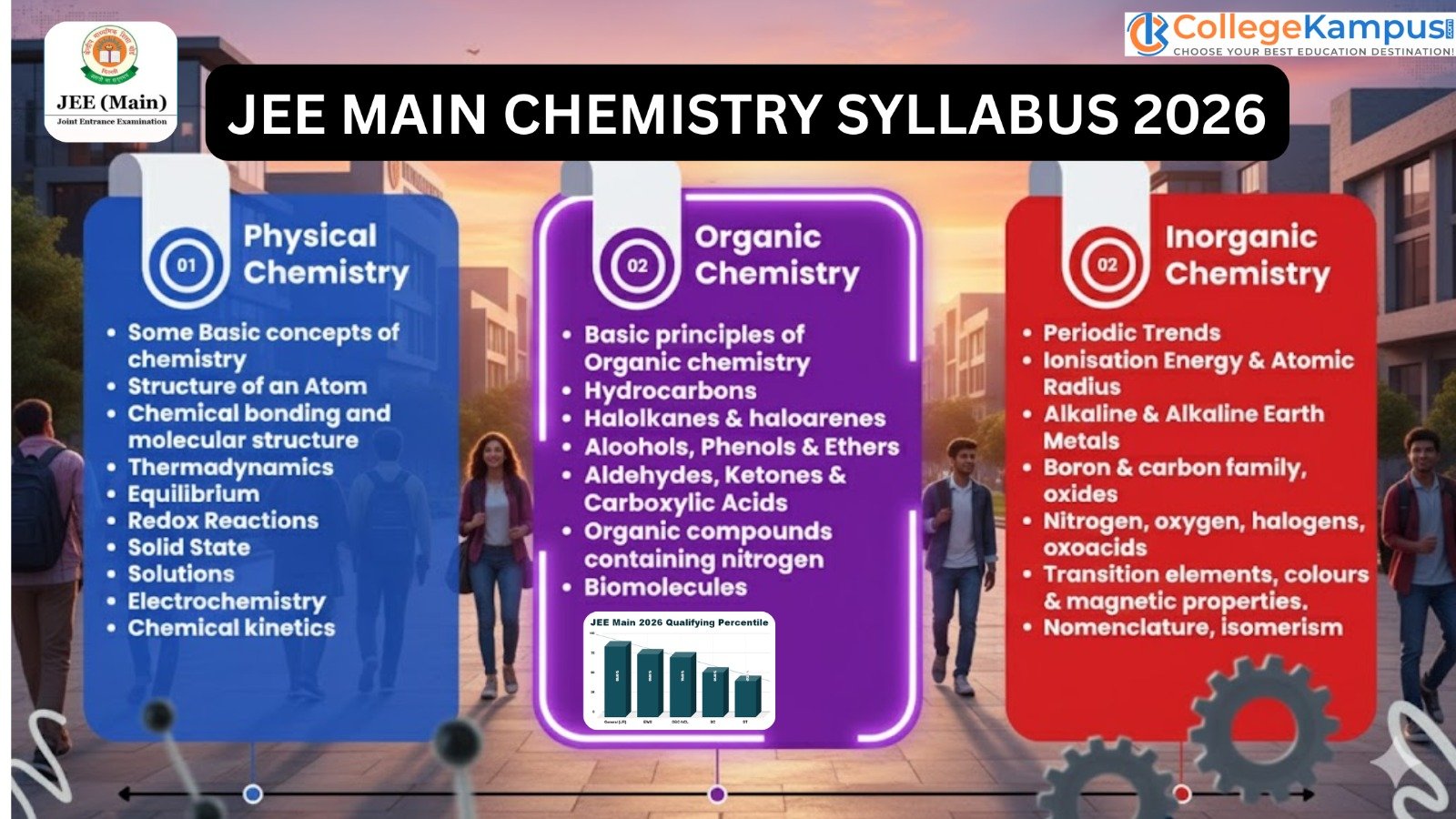
📘 JEE Main Physical Chemistry Syllabus 2026
The Physical Chemistry section consists of 8 chapters that test your understanding of the fundamental principles governing chemical reactions and physical states of matter.
🔹 Chapter-Wise Topics
1. Some Basic Concepts in Chemistry
- Matter and its nature
- Dalton’s atomic theory, atoms, molecules, elements, and compounds
- Laws of chemical combination, mole concept, percentage composition
- Empirical & molecular formulae, chemical equations, and stoichiometry
2. Atomic Structure
- Electromagnetic radiation, photoelectric effect
- Hydrogen atom spectrum, Bohr’s model & its limitations
- Dual nature of matter, de Broglie’s hypothesis, Heisenberg’s uncertainty principle
- Quantum numbers, shapes of orbitals, Aufbau principle, Hund’s rule, Pauli’s principle JEE Main Chemistry Syllabus 2026
3. Chemical Bonding and Molecular Structure
- Ionic and covalent bonding concepts
- Lattice enthalpy, Fajan’s rule, VSEPR theory, hybridization, resonance
- Molecular orbital theory, sigma & pi bonds, metallic bonding, hydrogen bonding
4. Chemical Thermodynamics
- System and surroundings, work, heat, internal energy, enthalpy
- First and second laws of thermodynamics, Hess’s law, enthalpy changes
- Entropy, Gibbs free energy, spontaneity, equilibrium constant
5. Solutions
- Concentration terms (molarity, molality, mole fraction)
- Raoult’s law, vapour pressure, ideal and non-ideal solutions
- Colligative properties and van’t Hoff factor JEE Main Chemistry Syllabus 2026
6. Equilibrium
- Physical and chemical equilibrium
- Law of mass action, equilibrium constants (Kc, Kp)
- Le Chatelier’s principle, ionic equilibrium, pH, buffer solutions
7. Redox Reactions and Electrochemistry
- Oxidation-reduction concepts, balancing redox reactions
- Electrolytic & galvanic cells, electrode potentials, Nernst equation
- EMF, fuel cells, conductance in electrolytic solutions
8. Chemical Kinetics
- Rate of reaction, factors affecting rate
- Rate law, order and molecularity
- First and zero-order reactions, Arrhenius equation, activation energy
JEE Main Chemistry Syllabus 2026
⚗️ JEE Main Inorganic Chemistry Syllabus 2026
Inorganic Chemistry focuses on the properties, classification, and behavior of elements. It comprises 4 main chapters.
🔹 Chapter-Wise Topics
1. Classification of Elements and Periodicity in Properties
- Modern periodic law and periodic table
- Periodic trends: atomic/ionic radii, ionization enthalpy, electron gain enthalpy, oxidation states JEE Main Chemistry Syllabus 2026
2. p-block Elements (Groups 13–18)
- Electronic configurations and general trends
- Unique behavior of the first element in each group
3. d- and f-block Elements
- Transition elements: configuration, oxidation states, catalytic properties, complexes
- Lanthanoids and actinoids: electronic configuration, oxidation states, lanthanoid contractionv JEE Main Chemistry Syllabus 2026
4. Coordination Compounds
- Werner’s theory, ligands, coordination number, chelation
- Nomenclature, isomerism, valence bond theory, crystal field theory
- Uses in biological systems and metallurgy
🧬 JEE Main Organic Chemistry Syllabus 2026
Organic Chemistry tests your understanding of carbon compounds, their reactions, and mechanisms. There are 8 major chapters in this section.
🔹 Chapter-Wise Topics
1. Purification and Characterisation of Organic Compounds
- Purification techniques: crystallization, distillation, chromatography
- Qualitative and quantitative analysis, empirical/molecular formulae
2. Some Basic Principles of Organic Chemistry
- Hybridization, functional groups, homologous series
- Nomenclature, types of organic reactions, reaction intermediates
- Inductive, resonance, hyperconjugation effects
3. Hydrocarbons
- Alkanes, alkenes, alkynes, and aromatic hydrocarbons
- Mechanisms: halogenation, addition, polymerization, Friedel-Crafts reactions
4. Organic Compounds Containing Halogens
- Preparation and reactions of alkyl/aryl halides
- Substitution mechanisms, environmental effects of freons, DDT, etc.
5. Organic Compounds Containing Oxygen
- Alcohols, phenols, ethers, aldehydes, ketones, carboxylic acids
- Important reactions: dehydration, oxidation, reduction, aldol condensation
6. Organic Compounds Containing Nitrogen
- Amines: classification, structure, basicity
- Diazonium salts: synthesis and uses
7. Biomolecules
- Carbohydrates, proteins, enzymes, vitamins, nucleic acids, hormones
8. Principles Related to Practical Chemistry
- Detection of functional groups and elements
- Preparation of inorganic and organic compounds
- Titrimetric and qualitative analysis
JEE Main Chemistry Syllabus 2026
❌ Deleted Topics from JEE Main Chemistry Syllabus 2026 (NTA Revised)
The NTA has removed several outdated and overlapping topics to make the syllabus more concise. Below are the deleted topics category-wise:
JEE Main Chemistry Syllabus 2026
🧾 Physical Chemistry Deleted Topics
- Physical quantities, SI units, dimensional analysis
- Gas laws (Boyle’s, Charles’, Graham’s), real gas behavior
- Liquid and solid states (surface tension, viscosity, Bragg’s law, packing in solids)
- Thomson and Rutherford models of the atom
- Surface chemistry: adsorption, catalysis, colloids
⚗️ Inorganic Chemistry Deleted Topics
- Metallurgy (extraction, refining of metals)
- Hydrogen and its compounds
- s-block and detailed p-block elements (Groups 13–18 detailed compounds)
- Environmental Chemistry
🧪 Organic Chemistry Deleted Topics
- Polymers
- Chemistry in Everyday Life (medicines, detergents, preservatives)
JEE Main Chemistry Syllabus 2026
📋 Summary – JEE Main Chemistry Weightage (Approx.)
| Section | No. of Chapters | Weightage (Approx.) |
|---|---|---|
| Physical Chemistry | 8 | 30–35% |
| Inorganic Chemistry | 4 | 25–30% |
| Organic Chemistry | 8 | 35–40% |
🔍 Key Takeaways
- Focus on NCERT Class 11 & 12 chemistry chapters.
- Revise chemical bonding, thermodynamics, hydrocarbons, coordination compounds, and equilibrium thoroughly.
- Practice numerical problems from Physical Chemistry and mechanisms from Organic Chemistry.
- Stay updated with the deleted topics to avoid wasting time on removed content.
🎓 Final Words
The JEE Main Chemistry Syllabus 2026 is concise, conceptual, and NCERT-based. Focusing on understanding rather than rote learning will help you score high. For detailed preparation tips, previous year questions, and free counseling, visit:
👉 College Kampus JEE Main Porta
📘 JEE Main Chemistry Syllabus 2026
🔹 Physical Chemistry
| Chapter Name | Subtopics |
|---|---|
| Some Basic Concepts in Chemistry | Matter and its Nature, Dalton’s atomic theory, Concept of atom, molecule, element and compound. Laws of chemical combination, Atomic and molecular masses, mole concept, molar mass, percentage composition, empirical and molecular formulae. Chemical equations and stoichiometry. |
| Atomic Structure | Nature of electromagnetic radiation, photoelectric effect, spectrum of hydrogen atom, Bohr model & its limitations. Dual nature of matter, de Broglie relation, Heisenberg principle, quantum mechanics, atomic orbitals, quantum numbers, shapes of orbitals, Aufbau, Pauli & Hund’s rule, electronic configuration. |
| Chemical Bonding and Molecular Structure | Kossel-Lewis approach, ionic & covalent bonding, lattice enthalpy, electronegativity, dipole moment, VSEPR theory. Valence Bond Theory, hybridization, resonance, Molecular Orbital Theory, sigma & pi bonds, bond order, metallic & hydrogen bonding. |
| Chemical Thermodynamics | System & surroundings, state functions, entropy, types of processes. First law – work, heat, enthalpy, heat capacity, Hess’s law, enthalpy changes in various processes. Second law – spontaneity, ΔS, ΔG and equilibrium constant. |
| Solutions | Concentration units – molarity, molality, mole fraction, %, Raoult’s Law, ideal & non-ideal solutions. Colligative properties – lowering of vapour pressure, freezing point depression, boiling point elevation, osmotic pressure. Van’t Hoff factor and abnormal molar mass. |
| Chemical Equilibrium | Dynamic equilibrium, physical and chemical equilibria, Law of mass action, Kp, Kc, ΔG° and equilibrium constant. Le Chatelier’s principle, factors affecting equilibrium, ionic equilibrium, pH, buffer, solubility product, hydrolysis. |
| Redox Reaction & Electrochemistry | Oxidation and reduction concepts, balancing redox equations. Electrolytic & metallic conduction, molar conductivities, Kohlrausch’s law, galvanic & electrolytic cells, Nernst equation, EMF, batteries, fuel cells. |
| Chemical Kinetics | Rate of reaction, factors affecting rate, order & molecularity, rate law, zero & first order reactions, half-life, Arrhenius equation, activation energy, collision theory. |
🔹 Inorganic Chemistry
| Chapter Name | Subtopics |
|---|---|
| Classification of Elements & Periodicity in Properties | Modern periodic law, s, p, d, f block elements, periodic trends – radii, ionization enthalpy, electron gain enthalpy, valence, oxidation states, chemical reactivity. |
| p-block Elements | Group 13–18 elements: electronic configuration, trends, anomalous behavior of first elements in each group. |
| d- and f-block Elements | Transition and inner transition elements, electronic configuration, properties, oxidation states, colour, magnetic properties, alloys, KMnO₄, K₂Cr₂O₇, lanthanoid contraction. |
| Coordination Compounds | Werner’s theory, ligands, coordination number, IUPAC nomenclature, isomerism. Valence bond & crystal field theory, colour, magnetism, and applications in analysis, metallurgy, and biology. |
🔹 Organic Chemistry
| Chapter Name | Subtopics |
|---|---|
| Purification & Characterisation of Organic Compounds | Purification (crystallization, distillation, chromatography), qualitative & quantitative analysis, empirical & molecular formula calculations. |
| Some Basic Principles of Organic Chemistry | Tetravalency of carbon, hybridization, classification, nomenclature, isomerism, bond fission, intermediates, electronic effects, and organic reactions. |
| Hydrocarbons | Alkanes, alkenes, alkynes, aromatic hydrocarbons – structure, reactions, mechanisms, polymerization, and directive influence. |
| Organic Compounds Containing Halogens | Preparation, properties, substitution mechanisms, uses, and environmental effects of chloroform, iodoform, freons, DDT. |
| Organic Compounds Containing Oxygen | Alcohols, phenols, ethers, aldehydes, ketones, carboxylic acids – preparation, reactions, mechanisms, and tests. |
| Organic Compounds Containing Nitrogen | Amines and diazonium salts – classification, properties, basicity, reactions, and synthetic importance. |
| Biomolecules | Carbohydrates, proteins, vitamins, nucleic acids, hormones – structure and biological significance. |
| Principles Related to Practical Chemistry | Detection of elements & functional groups, inorganic/organic preparations, titrimetric analysis, salt analysis, thermochemical and kinetic experiments. |
❌ Deleted Topics from JEE Main Chemistry Syllabus
| Chapter Name | Deleted Topics |
|---|---|
| Some Basic Concepts in Chemistry | Units, measurements, precision, accuracy, significant figures, SI units, dimensional analysis. |
| States of Matter | Classification of matter, gas laws, kinetic theory, real gases, liquids & solids, Bragg’s law, packing, unit cell, electrical & magnetic properties. |
| Atomic Structure | Thomson and Rutherford models and limitations. |
| Surface Chemistry | Adsorption isotherms, catalysis, colloids, emulsions, Brownian movement, coagulation, Tyndall effect. |
| General Principles & Processes of Isolation of Metals | Metallurgy – occurrence, extraction (Al, Cu, Zn, Fe), thermodynamic & electrochemical principles. |
| Hydrogen | Isotopes, hydrides, H₂O, H₂O₂, hydrogen as fuel, preparation, and uses. |
| s-Block & p-Block Elements | Basic trends, compounds (borax, boric acid, silicates, etc.), industrial uses, biological importance, and groupwise detailed studies. |
| Environmental Chemistry | Pollution (air, water, soil), greenhouse effect, ozone depletion, pollutants, and control strategies. |
| Polymers | Polymerization types, natural/synthetic rubber, important polymers (nylon, polyester, bakelite). |
| Chemistry in Everyday Life | Drugs, food additives, preservatives, soaps, detergents, cleansing agents. |